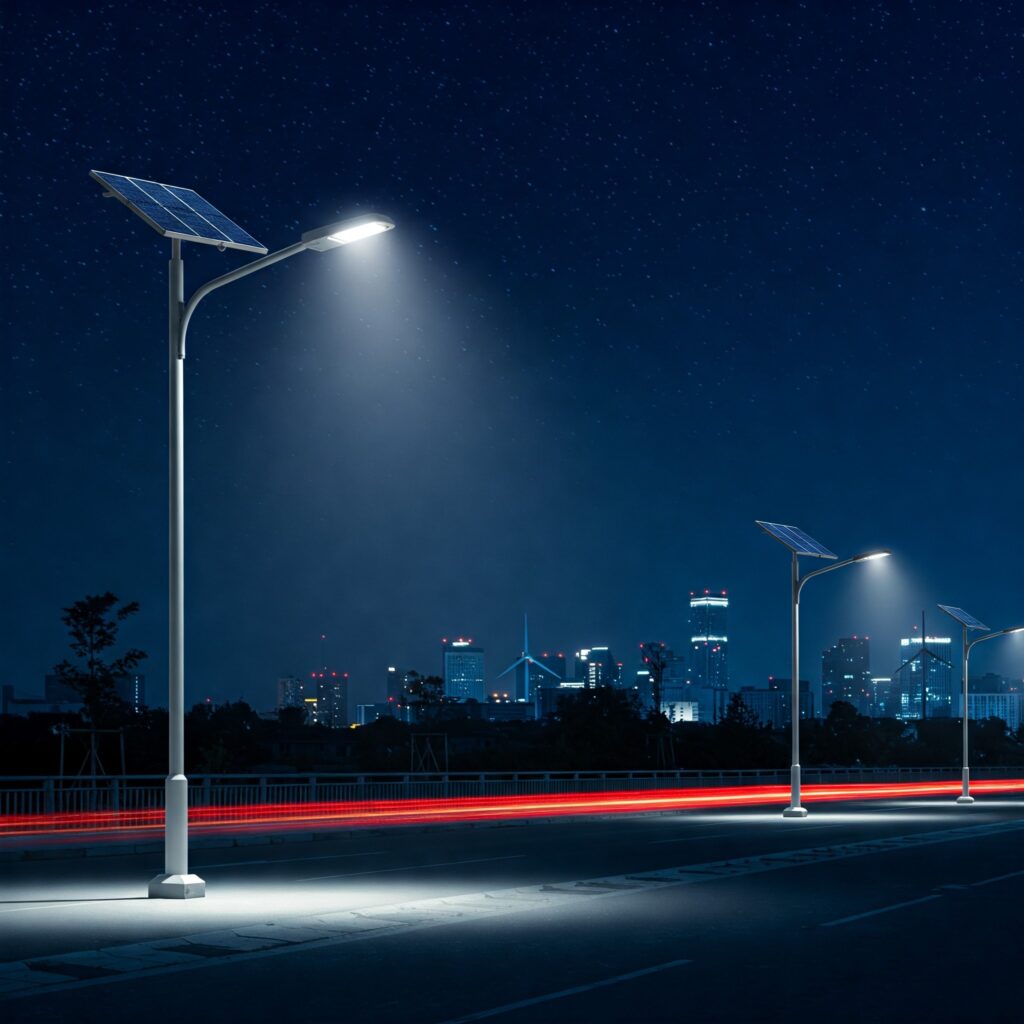
Choosing solar street lights for outdoor projects requires careful consideration of several technical factors. While product appearance and purchase price may influence the initial decision, long-term performance depends largely on battery life, solar panel efficiency, and LED lighting quality. These components work together to determine how reliably a solar street light operates throughout the year.
For importers, distributors, contractors, and project developers, comparing manufacturers requires more than reviewing advertised wattage or product descriptions. A reliable Top Solar Street Light Brand should provide clear specifications, dependable components, and products designed to meet different environmental and lighting requirements.
This guide compares the three most important performance areas and explains what buyers should evaluate before selecting a solar street light manufacturer.
1. Why Battery Life Matters in Solar Street Lights
The battery stores the electricity generated by the solar panel during daylight hours and supplies power to the LED module after sunset. Its capacity and performance directly affect how long the light can operate, especially during periods of limited sunlight.
A high-quality battery can improve system reliability and reduce the frequency of replacement. However, battery life depends on several factors, including battery chemistry, operating temperature, charging conditions, depth of discharge, and maintenance practices.
Battery Technologies to Compare
Two battery types commonly found in solar street lighting systems are lithium iron phosphate and lead-acid batteries.
Lithium iron phosphate (LiFePO4)
LiFePO4 batteries are widely used in modern solar lighting applications because they offer good thermal stability, relatively long cycle life, and suitability for repeated charging and discharging.
Potential advantages include:
- High usable energy capacity.
- Good charge and discharge performance.
- Lower weight than many traditional lead-acid alternatives.
- Suitable cycle life under recommended operating conditions.
- Reduced routine maintenance requirements.
Lead-acid batteries
Lead-acid batteries have been used in solar lighting systems for many years. They may have a lower initial purchase cost, but their weight, maintenance requirements, and usable depth of discharge can make them less attractive for some modern applications.
The best option depends on the project budget, operating environment, expected service life, and replacement requirements.
Important Battery Specifications
When comparing solar street light brands, examine more than the advertised ampere-hour rating.
Important specifications include:
- Rated voltage and capacity.
- Total and usable energy in watt-hours.
- Recommended depth of discharge.
- Charge and discharge cycle performance.
- Operating temperature range.
- Battery management system protection.
- Warranty conditions.
Buyers should also ask how many nights the system can operate without adequate solar charging. This is known as battery autonomy and is particularly important in locations with frequent cloudy or rainy weather.
2. Comparing Solar Panel Efficiency and Charging Performance
The solar panel determines how much energy the system can collect during the day. Its efficiency and rated power influence charging performance, but actual results also depend on sunlight availability, panel orientation, shading, and temperature.
A suitable solar panel should generate enough energy to recharge the battery while supporting the lighting system’s expected daily consumption.
Monocrystalline vs. Other Solar Panel Types
Monocrystalline panels are commonly used in modern solar street lights because they generally offer higher conversion efficiency than traditional polycrystalline panels.
Their relatively high power output per unit area can be useful when fixture dimensions or installation space are limited.
When comparing panels, consider:
- Solar cell technology.
- Rated maximum power.
- Conversion efficiency.
- Physical dimensions.
- Temperature performance.
- Weather resistance.
- Manufacturer specifications and test documentation.
Do not assume that a higher-wattage panel automatically provides better system performance. The panel must be appropriately matched to the battery capacity and LED power consumption.
Factors That Influence Charging Performance
Even an efficient solar panel may deliver inconsistent charging results if the installation conditions are unsuitable.
Common influencing factors include:
Sunlight availability: Locations with long periods of direct sunlight generally provide better charging opportunities than areas with frequent cloud cover.
Panel orientation: Incorrect positioning can reduce the amount of sunlight received throughout the day.
Shading: Trees, buildings, poles, and nearby structures may reduce panel output.
Dust and dirt: Accumulated surface contamination can limit sunlight reaching the solar cells.
Temperature: High panel temperatures can affect electrical output.
For international projects, buyers should consider local weather patterns and seasonal sunlight conditions when selecting solar panel capacity.
3. Evaluating LED Performance and Lighting Quality
The LED module determines how effectively stored battery energy is converted into illumination. Its performance influences brightness, energy consumption, lighting coverage, and overall user experience.
A solar street light should provide sufficient illumination for its intended application without consuming more energy than the system can reasonably generate and store.
Lumen Output and Luminous Efficacy
Lumen output measures the total amount of visible light produced by a fixture. Luminous efficacy, measured in lumens per watt, indicates how efficiently electrical power is converted into visible light.
Buyers should compare both values instead of relying only on advertised wattage.
A fixture with higher power consumption may produce less useful illumination than a more efficient model with a better LED design.
LED Chip Quality
The LED chips influence the fixture’s light output, efficiency, color consistency, and thermal behavior.
When evaluating a manufacturer, ask for information about the LED chip specifications, rated operating conditions, and supporting performance data.
Reliable component selection can contribute to consistent lighting performance and reduce the risk of premature failures.
Color Temperature and CRI
Color temperature affects the appearance of outdoor lighting.
- Warm white creates a softer appearance.
- Neutral white provides a balanced visual effect.
- Cool white produces a brighter-looking, more bluish appearance.
The appropriate choice depends on the application, visibility requirements, and local lighting standards.
Color rendering index (CRI) describes how accurately colors appear under a light source. Although high CRI may not be essential for every road-lighting project, it can be important in locations where color identification and visual clarity matter.
Optical Design and Light Distribution
LED performance is not determined by the light source alone. Lens design and optical distribution also influence how effectively illumination reaches the target area.
Check beam angles, mounting height, pole spacing, lighting uniformity, and glare control.
For larger projects, request IES photometric files or lighting simulations. These help project planners assess whether a selected fixture can provide suitable coverage.
4. Battery Life vs. Solar Panel Capacity vs. LED Efficiency
The three main components must work together. A high-capacity battery cannot compensate for an undersized solar panel, and an efficient solar panel cannot solve excessive energy consumption caused by an unsuitable LED configuration.
The following table summarizes their roles.
| Performance factor | Main function | What buyers should compare |
|---|---|---|
| Battery | Stores energy for nighttime operation | Usable capacity, cycle life, autonomy, temperature range |
| Solar panel | Generates electricity for charging | Rated power, efficiency, technology, charging conditions |
| LED module | Produces illumination | Lumen output, efficacy, chip quality, optical design |
| Controller | Manages energy and operation | Charging logic, dimming, protection features |
| Housing | Protects internal components | Materials, thermal management, IP rating, corrosion resistance |
A well-designed solar street light balances these elements according to the project’s operating requirements.
5. How to Compare Different Solar Street Light Brands
When evaluating manufacturers, buyers should request comparable technical information for each product. Comparing one brand’s battery capacity with another brand’s LED wattage, for example, will not provide a meaningful performance assessment.
A structured comparison should cover the following areas.
Battery Specifications
Check the battery chemistry, voltage, capacity, usable energy, and expected cycle performance. Ask for information about the operating conditions used to determine the manufacturer’s battery-life claims.
Solar Panel Specifications
Compare rated power, cell technology, conversion efficiency, dimensions, and relevant test data.
LED Performance
Review actual lumen output, luminous efficacy, LED chip specifications, color temperature, and photometric information.
System Autonomy
Confirm the number of operating hours per night and the expected backup duration during periods of limited sunlight.
Warranty and Support
Check whether the manufacturer provides separate warranty coverage for the battery, solar panel, LED module, and controller.
A detailed comparison helps buyers identify meaningful differences instead of relying on promotional claims.
6. The Importance of Intelligent Controllers
The controller connects the energy generation, storage, and lighting functions. It manages battery charging, prevents certain electrical problems, and determines how the LED module operates.
Modern solar street lights may include programmable dimming, automatic dusk-to-dawn switching, motion detection, and battery monitoring.
These functions can help manage energy consumption and extend operating autonomy.
For example, a programmable controller may reduce brightness during periods of low activity and increase it when movement is detected. This can conserve battery energy while maintaining useful illumination.
Before purchasing, confirm which control functions are included and whether they can be adjusted to match project requirements.
7. Weather Resistance and Operating Conditions
Battery performance, solar charging, and LED operation can all be affected by environmental conditions.
A solar street light installed in a hot region may require components designed for elevated temperatures. Coastal locations may need stronger corrosion protection, while areas with heavy rainfall require suitable water resistance.
Important features to review include:
- IP protection rating.
- Corrosion-resistant housing.
- UV-resistant external materials.
- Operating temperature range.
- Battery temperature protection.
- Secure electrical connections.
- Effective LED heat dissipation.
For example, IP65 indicates dust-tight protection and resistance to water jets under specified testing conditions. Buyers should verify the rating of the relevant assembly and ensure it matches the installation environment.
8. Certifications and Technical Documentation
Technical documents help buyers verify whether product specifications are supported by appropriate testing.
Depending on the destination market and product configuration, relevant documentation may include CE-related conformity records, RoHS compliance information, electrical safety reports, and electromagnetic compatibility testing.
For LED performance, buyers may request photometric reports such as LM-79 reports where applicable. LM-80 data may also be relevant when assessing LED package lumen maintenance.
Battery documentation should identify the battery chemistry, capacity, operating conditions, and applicable transportation or safety requirements.
Always confirm that the documents correspond to the exact model being purchased. A certificate or test report for one product should not automatically be treated as proof of compliance for an entire product range.
9. Consider Total Cost Rather Than Purchase Price Alone
The cheapest solar street light may not provide the best long-term value. Battery replacement, maintenance, component failures, and installation expenses can significantly affect the total project cost.
When comparing quotations, consider:
- Initial product price.
- Solar panel and battery specifications.
- LED efficiency and lighting performance.
- Installation requirements.
- Expected maintenance expenses.
- Replacement component availability.
- Warranty coverage.
- Shipping and import costs.
For distributors and project contractors, a slightly higher initial investment may be worthwhile if the product offers better reliability and lower maintenance requirements.
Ask manufacturers for detailed quotations that clearly identify all included components and services.
10. Practical Testing Before Bulk Purchasing
Technical specifications are important, but actual product testing can reveal performance differences that may not be obvious from a catalog.
Request samples from shortlisted manufacturers and evaluate them under conditions similar to the intended installation.
Useful checks include:
- Inspect the housing, mounting structure, and electrical connections.
- Verify the solar panel specifications and charging behavior.
- Review battery capacity and charging protection.
- Measure or independently verify LED light output where practical.
- Test automatic switching and dimming functions.
- Observe nighttime operating duration.
- Review the product’s performance under expected environmental conditions.
For large installations, a pilot project can help confirm whether the selected system provides suitable illumination and battery autonomy before the full order is placed.
11. Questions to Ask a Solar Street Light Manufacturer
Before selecting a supplier, prepare a list of technical and commercial questions. Clear answers can help distinguish manufacturers with detailed product knowledge from those relying mainly on general marketing claims.
Consider asking:
- What battery technology and usable capacity does the product provide?
- How many nights of autonomy can the system support?
- What is the solar panel’s rated power and efficiency?
- What is the LED module’s actual lumen output?
- Which controller protections and lighting functions are included?
- What are the operating temperature limits?
- Which test reports and compliance documents are available?
- What warranty applies to each major component?
- Are replacement batteries and controllers available?
- Can the manufacturer provide samples and independent inspection support?
The answers should be supported by product datasheets, test documents, and written commercial terms.
Conclusion
Comparing solar street light brands requires a complete understanding of battery performance, solar panel efficiency, and LED lighting quality. These three elements work together to determine energy generation, storage capacity, nighttime illumination, and overall system reliability.
Buyers should also evaluate intelligent controls, weather resistance, certifications, warranty coverage, and total ownership costs. A product with impressive individual specifications may still underperform if its components are not properly matched.
For importers, distributors, contractors, and project developers, the most effective approach is to compare complete system specifications, request samples, verify technical documentation, and test products under realistic conditions. This process makes it easier to select solar street lights that meet project requirements and provide dependable outdoor lighting over the long term.