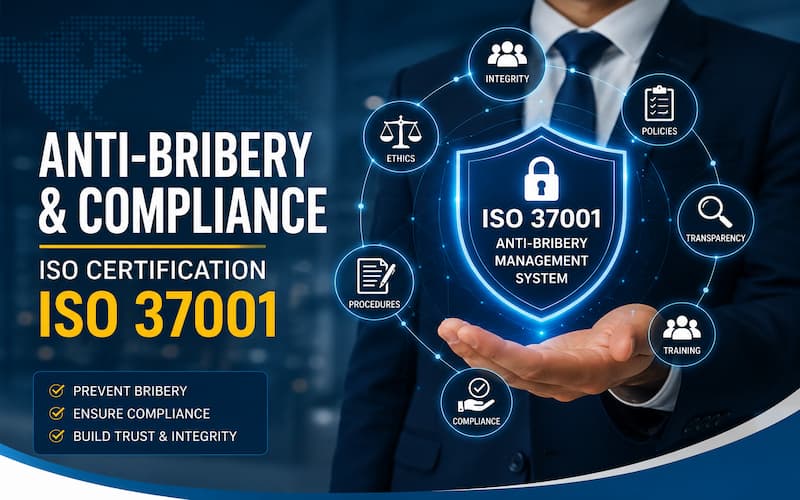
With the ongoing economic transformation in Saudi Arabia as part of Vision 2030, organizations should expect to be held to a higher standard of transparency, accountability and ethical business conduct. International management systems are gaining traction across all industries as a way to improve governance and management of compliance risks. The ISO 37001 is one of the best available standards in this regard, which offers a structured approach to prevent, detect and respond to bribes. The ISO 37001 certification process in Saudi Arabia is a trusted investment in an anti-bribery management system that promotes trust, strengthens compliance, and contributes to an organization’s sustainable success.
With the increased engagement with government bodies, international partners and multinational clients, implementing ISO 37001 for Businesses in Saudi Arabia is gaining significance. Certification is a means of showing a company’s commitment to ethical behaviour and also assists organisations meet their legal and regulatory obligations. Saudi businesses can build reputation, enhance operational integrity, and enjoy competitive advantage in both local and international markets, by adopting this standard.
Understanding ISO 37001 Certification
The International Organization for Standardization (ISO) has published an anti-bribery management system (ABMS) standard called ISO 37001. It assists organizations to create policies, procedures and processes that will mitigate bribery in business activities. Applicable to businesses of all sizes, including private businesses, government agencies, non-profit organizations and multinational corporations.
The framework seeks to encourage organisations to perform due diligence, implement financial and operational controls, train employees about bribery, set up reporting systems and regularly review the effectiveness of anti-bribery controls. ISO 37001 is not about tackling corruption after it has happened but fostering a proactive culture of integrity and compliance.
Why Saudi Businesses Need ISO 37001 Certification
In recent years, Saudi Arabia has made considerable efforts to improve corporate governance, transparency and compliance with regulations. With businesses entering the international markets and taking part in large infrastructure and government projects, it is more important than ever to have ethical business practices.
By adopting ISO 37001 for Businesses in Saudi Arabia, companies can ensure that they take an active role in preventing bribery and satisfy regulatory, investor, customer and business partner expectations. Certification also helps organisations to align to national policies and programmes to enhance corporate governance and diminish corruption.
Supports Vision 2030 Goals
Transparency, accountability, and sustainable economic development are encouraged through Saudi Vision 2030. International best practices in the field of good governance and investor confidence are encouraged in the business community.
ISO 37001 directly contributes to these goals by laying down a well-defined anti-bribery policy, assigning anti-bribery management responsibilities and setting up an effective anti-bribery monitoring system. Organisations which achieve ISO 37001 certification help create a more robust and transparent business landscape, with a long-term economic vision for the Kingdom.
Strengthens Corporate Reputation
Reliability is one of the most valuable resources of an organization. Organizations with a sound ethics track record are more likely to gain more customers, investors, suppliers, and strategic partners.
Having ISO 37001 certificate is a strong signal demonstrating that the organisation has put in place internationally recognised controls to prevent bribery and corruption. This dedication boosts brand standing, builds investor trust, and sets the company apart from rivals.
Good reputation also can lead to better opportunities for multi-national companies that have ethical compliance as a priority in their supply chain.
Comprehends legal and financial risks and reduces them.
Bribery incidents are costly, may lead to legal sanctions, tarnish the company’s image, and disrupt operations. Even if it doesn’t lead to a conviction, unfounded accusations can hurt customer loyalty and investor sentiment.
By using ISO 37001, organisations can find out where risk may exist, and take steps to prevent it before it happens. Businesses can reduce risk of incidents relating to bribery through risk assessment, due diligence, financial controls, approval processes and internal audit.
These risks can have a negative impact on the organization’s finances and sustainability, so minimizing them is a good thing.
Improves Compliance with Regulations
Saudi Arabia is continuing to implement and enhance regulatory oversight in different sectors. Compliance requirements apply to businesses when they operate internationally and must be met in addition to local laws.
Compliance is documented, compliance responsibilities are assigned, records are maintained and performance monitored continuously throughout with ISO 37001 offering a systematic approach.
This document will help to streamline the regulatory inspection process and provide evidence of the implementation of suitable regulatory response measures.
Enhances Employee Awareness
A lot of bribery dangers stem from the fact that staff are not aware of the company policy or legal requirements. The focus for ISO 37001 is on developing the education and awareness of employees about acceptable business practices and ensuring their ongoing development.
Staff receive training to identify potential bribery scenarios, know how to report any instances of potential corruption and make good decisions in difficult situations. This develops a work ethos that promotes integrity as an integral part of business practice, not just a policy on the page.
Compliance is the responsibility of employees who know what’s required, and they play a big role in mitigating organizational risk.
Improves internal control
Good governance relies on good internal controls. The ISO 37001 standard stipulates that businesses implement bribery reduction procedures, including procedures for approvals, financial monitoring, supplier evaluation, and documentation, to minimize the chances for bribery.
The controls increase transparency in business processes and facilitate the detection of abnormal transactions or suspicious activities.
Better internal controls also enhance overall operational efficiency, providing proper documentation and adherence to processes.
Increases Business Opportunities
Organizations with good compliance can attract numerous clients from government agencies, multinational corporations, and international clients.
Certification offers assurance of adherence to international best practice in anti-bribery, and can help to make the company more competitive in bidding for contracts, tendering for contracts, or entering new markets.
International expansion can be a differentiator for companies when evaluating and tendering for suppliers, especially when the company is ISO 37001 certified.
Promotes good business practices
Ethical culture begins with a commitment to leadership. Top management must actively champion anti-bribery measures, share anti-bribery principles with the organisation and provide anti-bribery resources.
If leadership sets the example, they are more likely to embody the ethical standards of the company and to come forward with concerns without fear of repercussions.
This integrity-driven culture fosters greater collaboration, boosts employee satisfaction, and ensures long-term business success.
Improves Risk Management
Businesses are exposed to various risks when it comes to bribery based on their industry, customers, suppliers and geographic presence.
ISO 37001 sets out a framework for businesses to conduct regular risk assessments to identify areas that can be vulnerable and take necessary action to prevent it.
Continuous monitoring allows organisations to respond to new and evolving risks and to adapt to new regulatory and business environments.
Encourages trade with the rest of the world
Saudi businesses are more interdependent with international businesses and participating in international supply chains. Overseas organisations will demand suppliers to provide evidence of adherence to the international accepted management standards.
By adopting ISO 37001 Businesses in Saudi Arabia can satisfy these expectations and streamline transactions with businesses across borders.
The certification will help to build credibility in international markets, since it certifies the adherence of the company with internationally recognized anti-bribery practices.
Helps develop Long-Term Business Sustainability
Sustainable businesses are based on transparency, accountability and responsible governance. Effective compliance risk management will mean organizations are better equipped to run their business in a stable way when there are regulatory or economic changes.
Continuous improvement is improved with regular audits, management reviews, corrective actions and monitoring of performance through ISO 37001.
The continuous enhancements allow the enterprises to stay competitive and gain stakeholders’ trust in long-term operations.
The Certification Process
The process of certification usually starts by the person understanding the risk of an organization and analysing the gap between the requirements of ISO 37001 and the organization. From there, businesses create anti-bribery policies and internal controls, and offer training to employees and document systems.
After the management system is up and running, internal audits and management reviews are conducted to ensure the effectiveness of the management system, followed by external audits carried out by an accredited certification body. Once the system is successfully certified, organizations then conduct surveillance audits to check on the system and make further improvements, to ensure that the system will remain compliant.
Conclusion
With Saudi Arabia continuing to take steps to bolster corporate governance and encourage ethical business practices, ISO 37001 has emerged as a vital management system for businesses aiming for sustainable growth. Certification assists businesses avoid bribery, enhance compliance, boost internal controls and assure trust with customers, investors, and regulators. Implementing ISO 37001 for Businesses in Saudi Arabia is a testament to an organization’s dedication to transparency and a way to minimize operational and legal risks.
Making the decision to adopt the standard is not about compliance; it’s about investing in long-term business success. Completing the certification process puts organisations on a path to becoming trusted, responsible and globally competitive businesses. With the increasing demand for ethical business practices, ISO 37001 for Businesses Saudi Arabia will continue to be a highly useful tool for businesses striving for excellence, credibility and sustainable development.