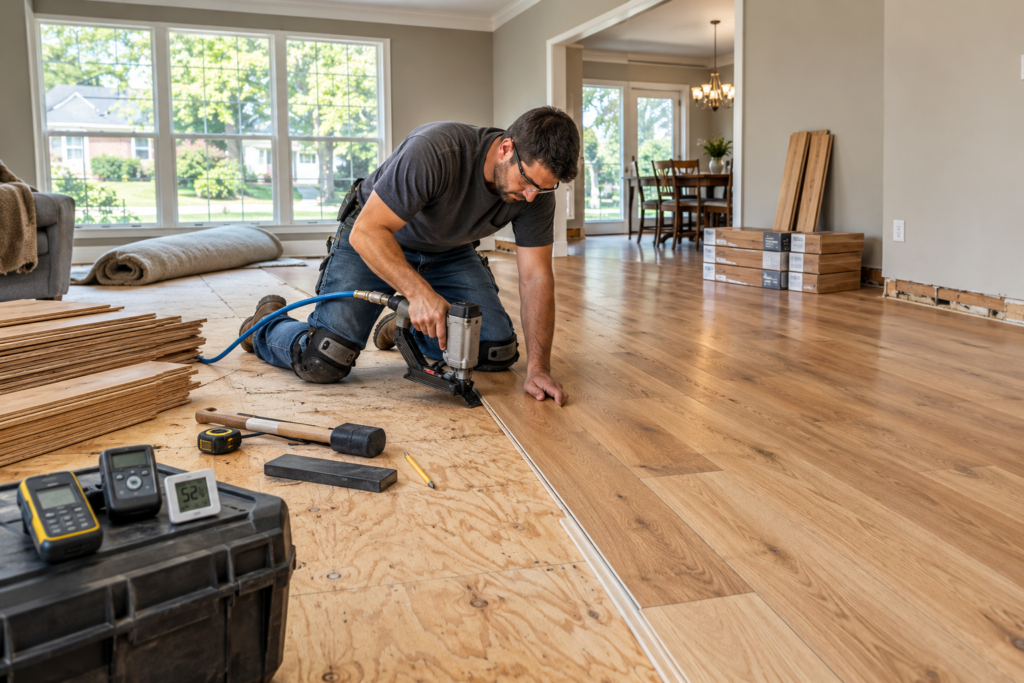
A couple buys an older home in north Fulton County, pulls up the worn carpet, and finds a dusty plywood subfloor. Now they have to decide what comes next. For many homeowners, that decision leads to hardwood flooring installation in Alpharetta GA, a project that adds warmth, character, and long-term value to a home.
Hardwood is more than a pretty surface, though. How it’s installed matters as much as the wood itself. Georgia’s humid climate, local building styles, and the way families actually live all affect how a floor performs over time.
This guide covers what goes into a successful installation, why it’s worth the effort, and the questions homeowners ask most often.
Why Installation Matters as Much as the Wood
Two homes can use the exact same oak planks and end up with very different floors. One stays tight and quiet for decades. The other starts cupping, gapping, or squeaking within a few years.
The difference usually comes down to preparation. A floor sits on a system that includes the subfloor, the moisture barrier, the fasteners or adhesive, and the air in the room. If any part of that system is off, the wood will show it.
That’s why experienced installers spend so much time on work most homeowners never see.
The Role of Georgia’s Climate
Summers in the metro Atlanta area are hot and sticky, and winters bring dry, heated indoor air. Wood responds to those changes by absorbing and releasing moisture. It expands in humid months and shrinks when the air turns dry.
Good installers plan for this movement. They leave proper expansion gaps along the walls. They also let the wood acclimate inside the home before it goes down, often for several days, so it adjusts to the room’s normal conditions.
Most hardwood performs best when indoor humidity stays roughly between 35 and 55 percent. A well-run HVAC system does a lot of the heavy lifting here.
Subfloors: Crawlspaces vs. Slabs
Many homes in the area sit over crawlspaces, while newer builds and basements often rest on concrete slabs. Each setup calls for a different approach.
Crawlspace homes usually have a wood subfloor, which works well for traditional nail-down solid hardwood. Still, crawlspaces in Georgia can trap moisture. Installers often check for proper vapor barriers and ventilation before laying a single board.
Concrete slabs are a different story. Solid hardwood generally isn’t nailed over concrete, so engineered hardwood is the common choice. It can be glued down or floated over an underlayment, and it handles moisture swings with more stability.
Solid vs. Engineered Hardwood
This is one of the first choices homeowners face, and there’s no single right answer.
Solid hardwood is milled from one piece of wood. It can be sanded and refinished many times over its life, which makes it a favorite for main living areas and older homes with wood subfloors.
Engineered hardwood has a real wood top layer bonded to a stable core. It resists warping better and works in places solid wood struggles, like basements or rooms over slabs. Depending on the wear layer’s thickness, it can often be refinished once or twice.
A simple rule of thumb: if the subfloor is wood and the space stays dry, solid hardwood is a strong option. If moisture or concrete is involved, engineered usually makes more sense.
Prefinished or Site-Finished?
Prefinished boards arrive already sanded, stained, and sealed. Installation moves faster, there’s less dust, and families can often walk on the floor right away.
Site-finished floors are installed raw, then sanded and finished in place. This takes longer and requires the home to be cleared out for a few days. The payoff is a perfectly smooth, sealed surface with custom stain colors and no small bevels between boards.
Busy households often lean toward prefinished. Homeowners chasing a specific look, or matching existing floors, tend to choose site-finished.
The Benefits Homeowners Notice Most
The first thing people notice is how a room feels. Hardwood brings a natural warmth that’s hard to replicate. It also makes spaces feel more open and connected, especially when it runs continuously through main living areas.
Durability is another major draw. A well-installed hardwood floor can last for generations. When it starts to look tired, it can be refinished rather than replaced, which isn’t true of carpet or most other flooring.
Hardwood is also easier to keep clean. It doesn’t hold onto dust, pet dander, or allergens the way carpet does. A quick sweep and an occasional damp mop with a wood-safe cleaner are usually enough.
Then there’s resale value. Real estate agents across the region regularly point to hardwood as a feature buyers look for. It rarely goes out of style, and it photographs well in listings.
Common Mistakes That Shorten a Floor’s Life
Most flooring problems trace back to a handful of avoidable issues. Skipping acclimation is one of the biggest. Wood brought straight from a cold delivery truck into a warm home can shift noticeably after installation.
Another common problem is ignoring subfloor flatness. Dips and humps lead to hollow spots, squeaks, and uneven wear. A careful installer checks the surface and levels it before starting.
Moisture testing gets overlooked too often. Both wood subfloors and concrete slabs should be checked with a moisture meter. Laying hardwood over a damp base almost always ends in cupping or buckling.
Finally, tight installs against walls leave the wood nowhere to expand. Baseboards and trim hide the small gap, so there’s no reason to skip it.
Real-World Scenarios
Consider a family with two large dogs and young kids. They want hardwood but worry about scratches. In cases like this, installers often suggest harder species like hickory or white oak, along with a matte or wire-brushed finish that hides wear better than high gloss.
Then there’s the empty-nester couple renovating a 1990s home. Their subfloor is solid, the rooms are dry, and they want a classic look. Site-finished solid oak with a custom stain fits their timeline and style.
A third homeowner is finishing a basement over concrete. Solid hardwood isn’t practical there, so engineered hardwood or another moisture-friendly product becomes the better fit.
Not every project calls for real wood, either. Rental owners and budget-focused buyers sometimes compare hardwood against laminate. In smaller Georgia towns outside Athens, for example, laminate flooring installation in Watkinsville, GA is a popular choice for rental homes and high-traffic spaces where cost and scratch resistance come first.
Local installers such as Lica Hardwood Floors LLC often note that the right choice depends less on trends and more on how a space is used every day.
Hardwood or Laminate: Weighing the Tradeoffs
Laminate has improved a lot in recent years. Many products now mimic wood grain convincingly, and they resist scratches well. It’s also faster to install and usually costs less upfront.
The tradeoff is lifespan. Laminate can’t be sanded or refinished, so once it’s worn or damaged, it needs replacing. Hardwood costs more initially but can be renewed many times.
Homeowners comparing quotes for laminate flooring installation in Watkinsville, GA against hardwood elsewhere in the state often find the decision comes down to how long they plan to stay. Short-term owners may lean toward laminate. Long-term owners usually find hardwood pays off.
Final Thoughts
Hardwood can transform a home, but only when it’s installed with care. Climate, subfloor type, wood choice, and finish all play a part in how the floor looks and performs over time.
For anyone planning hardwood flooring installation in Alpharetta GA, the best next step is simple: ask any installer how they handle moisture testing, acclimation, and subfloor prep. Their answers will tell you a lot about the quality of the finished floor.
Frequently Asked Questions
How long does hardwood flooring installation take?
Most average-sized rooms take one to three days for prefinished wood. Site-finished floors need extra time for sanding, staining, and drying, often adding several days.
Can hardwood be installed over concrete?
Solid hardwood generally isn’t recommended directly over concrete. Engineered hardwood, glued down or floated, is the more common and stable option for slabs.
How long should hardwood acclimate before installation?
Many manufacturers recommend at least three to five days in the home. The exact time depends on the product and the moisture readings of the wood and subfloor.
Is hardwood a good choice in humid climates like Georgia?
Yes, as long as indoor humidity is managed and the floor is installed with proper expansion gaps. Engineered hardwood offers extra stability in moisture-prone areas.
How often does a hardwood floor need refinishing?
Most floors need refinishing every 7 to 15 years, depending on foot traffic, pets, and how well the finish is maintained.