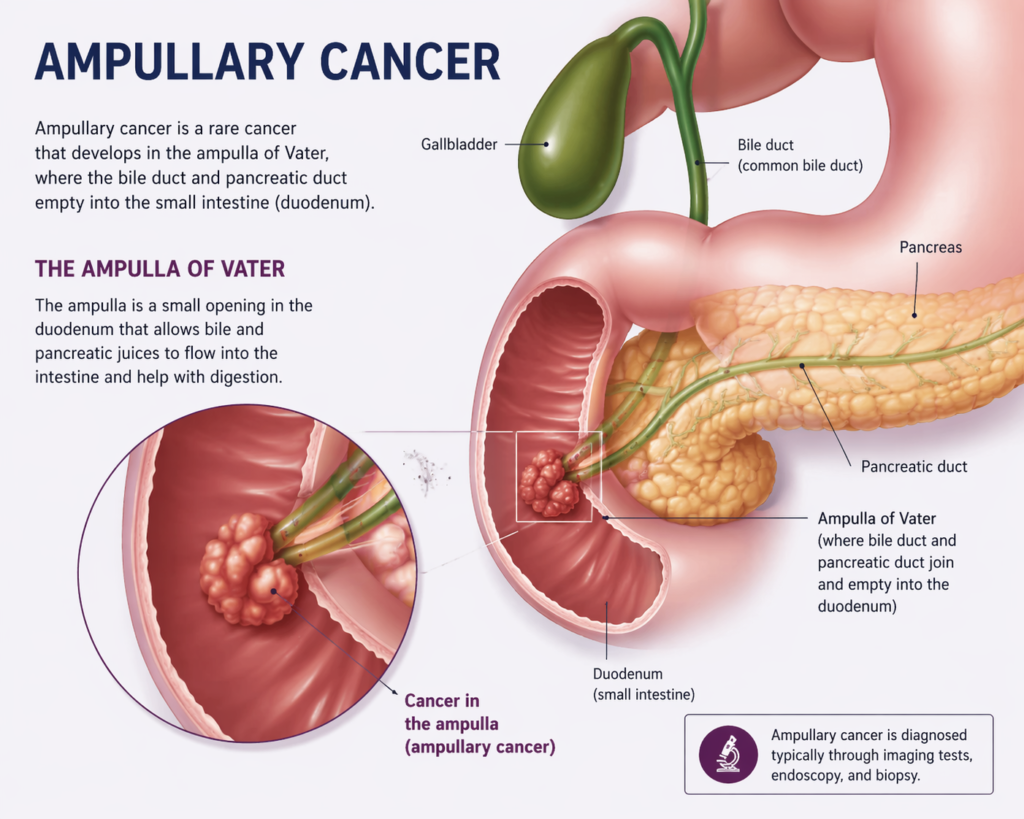
Ampullary Cancer
Have you ever noticed how some serious health conditions start with symptoms that feel “too normal” to worry about? That’s exactly the challenge with ampullary cancer. It often begins quietly, and many people first mistake it for common digestive issues.
So, what are the causes of ampullary cancer, and how do doctors actually confirm it? In this guide, we’ll walk through the full diagnosis process simply—starting from early symptoms, moving into tests, imaging, and finally biopsy and staging. Let’s break it down step by step so it feels easier to understand.
Understanding Ampullary Cancer and Why Diagnosis Isn’t Straightforward
Where does this cancer start?
Ampullary cancer begins in a small but important area called the ampulla of Vater. This is where the bile duct and pancreatic duct meet and empty into the small intestine.
Moreover, this area plays a key role in digestion. So, when something goes wrong here, it can affect how bile and digestive juices flow.
Why is early detection often delayed
Well, here’s the thing—early symptoms are not very specific. They often look like common stomach or liver problems.
In addition, the tumor grows in a hidden location inside the body. So, it doesn’t show obvious external signs at first.
However, as it slowly blocks bile flow, symptoms start becoming more noticeable. That’s usually when diagnosis begins.
Now that we understand the location and challenge, let’s look at the early symptoms that usually trigger medical tests.
Early Symptoms That Lead to Diagnosis
Signs that usually raise concern
Ampullary cancer often shows up through changes in digestion and liver function. These symptoms may seem mild at first but gradually become more obvious.
Common early signs include:
- Yellowing of the skin or eyes (jaundice)
- Abdominal discomfort or pain
- Sudden weight loss
- Dark urine
- Pale or clay-colored stools
- Nausea or poor appetite
Moreover, jaundice is often the most noticeable symptom and usually brings people to the doctor.
Why are symptoms easy to misread?
However, these signs can also appear in less serious conditions like gallstones or infections. That’s why diagnosis is not immediate.
In addition, symptoms may develop slowly, making them easy to ignore in the beginning.
So, once symptoms raise suspicion, doctors move to the first clinical check. Let’s see what happens next.
First Step in Diagnosis: Clinical Examination
What happens during your first visit?
When you first see a doctor, they don’t jump straight into advanced tests. Instead, they start with a detailed discussion about your symptoms.
Moreover, they will ask when the symptoms started, how they changed, and whether you noticed patterns like worsening jaundice or pain.
Physical check and early clues
In addition, the doctor will do a physical examination. They may check for:
- Yellowing of eyes and skin
- Abdominal swelling or tenderness
- General signs of weakness
Well, here’s the thing—this step doesn’t confirm cancer, but it helps doctors decide which tests to order next.
So, after clinical evaluation, the next step usually involves blood work.
Blood Tests and Lab Work: What Do They Show?
Why blood tests matter
Blood tests are often the first technical step in diagnosis. They help doctors understand how your liver and digestive system are functioning.
Moreover, they can point toward bile duct blockage, which is common in ampullary cancer.
Common tests used
Doctors usually check:
- Liver function tests (LFTs)
- Bilirubin levels
- Tumor markers like CA 19-9
In addition, high bilirubin levels often explain jaundice symptoms.
What blood tests cannot do alone?
However, blood tests alone cannot confirm cancer. They only suggest that something abnormal is happening.
So, when results look suspicious, doctors move to imaging tests to get a clearer picture. Let’s explore that next.
Imaging Tests Used to Detect Ampullary Cancer
How doctors “see” inside the body
Imaging tests help doctors locate the exact problem inside the digestive system. These tests are crucial for identifying blockages or tumors.
Moreover, they provide a visual map of the bile ducts, pancreas, and surrounding areas.
Common imaging methods
Doctors may use:
- Ultrasound (first quick check)
- CT scan (detailed cross-sectional images)
- MRI or MRCP (for bile and pancreatic ducts)
In addition, each test provides a different level of detail, so sometimes more than one is needed.
Why imaging is so important
However, imaging still doesn’t confirm cancer fully. It only shows abnormal growth or blockage.
So, when something suspicious appears, doctors take the next important step—endoscopy and biopsy.
Endoscopy and Biopsy: Confirming the Diagnosis
What happens during endoscopic tests?
Endoscopy allows doctors to look directly inside the digestive tract using a thin camera. One common procedure is ERCP (Endoscopic Retrograde Cholangiopancreatography).
Moreover, this helps doctors see blockages in the bile or pancreatic ducts clearly.
Taking a tissue sample
In addition, doctors may take a small tissue sample (biopsy) from the suspicious area. This sample is then tested in a lab.
Well, here’s the thing—this is the most important step in confirming ampullary cancer.
Why is a biopsy necessary?
However, imaging alone cannot confirm the exact type of cells involved. Only a biopsy can do that.
So, once results come back, doctors finally confirm the diagnosis and move toward staging.
Let’s understand what staging means next.
Staging After Diagnosis: Why It Matters
What staging actually tells doctors
Staging shows how far the cancer has spread in the body. It helps doctors decide the best treatment plan.
Moreover, ampullary cancer is usually divided into stages from early (localized) to advanced (spread).
Why early stage matters
In addition, early-stage detection often means more treatment options and better outcomes.
However, later stages may require more complex treatment approaches.
How staging is determined
Doctors use results from:
- Imaging tests
- Biopsy results
- Surgical findings (if needed)
So, staging brings all the diagnostic information together into one clear picture.
Now that we understand the full process, let’s wrap it up.
Conclusion: Key Takeaways on How Ampullary Cancer Is Diagnosed
Diagnosing ampullary cancer is not a single-step process. It involves careful observation, testing, imaging, and finally a biopsy to confirm what’s happening inside the body. Most symptoms start small, which is why early attention matters.
Here’s a quick summary:
- Early symptoms include jaundice, weight loss, and abdominal pain
- Blood tests show liver and bile duct changes
- Imaging helps locate blockages or tumors
- Endoscopy and biopsy confirm the diagnosis
- Staging decides the treatment path
Moreover, understanding this process helps you respond early instead of waiting for symptoms to worsen.
If you want to stay informed about ongoing medical advancements, you can also get involved in renal cell carcinoma clinical research and explore how new studies are improving cancer diagnosis and care.