Achieve Powerful Business Security with ISO 27001 Certification in India
In today’s rapidly evolving digital environment, protecting sensitive business information has become a major priority for organisations across India. Businesses handle large volumes of confidential information, including customer records, financial details, employee data, intellectual property, and operational documents. Without effective security measures, organisations may face cyberattacks, data breaches, financial losses, and reputational damage. ISO 27001 Certification in India provides a structured approach to managing information security risks and strengthening an organisation’s ability to protect valuable data.
What Is ISO 27001 Certification?
ISO/IEC 27001 is an internationally recognised standard for Information Security Management Systems (ISMS). It provides a framework that helps organisations establish, implement, maintain, and continually improve their information security practices.
The standard focuses on three important principles: confidentiality, integrity, and availability of information. Confidentiality ensures that sensitive information is accessible only to authorised individuals. Integrity protects information from unauthorised modifications, while availability ensures that data and systems remain accessible whenever required.
By implementing ISO 27001 requirements, businesses can identify potential security threats, evaluate risks, and establish appropriate controls to protect their information assets.
Why Is ISO 27001 Certification Important for Indian Businesses?
India’s growing digital economy has increased the importance of information security across industries. IT companies, financial institutions, healthcare providers, manufacturing organisations, educational institutions, and service providers regularly manage sensitive information.
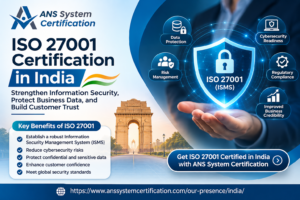
ISO 27001 Certification in India helps businesses develop a systematic security framework that addresses potential vulnerabilities and improves their overall risk management capabilities.
Some important reasons to obtain certification include:
- Enhanced Data Protection: Helps safeguard confidential business and customer information against unauthorised access, misuse, and data breaches.
- Improved Risk Management: Supports the identification, assessment, and treatment of information security risks.
- Customer Confidence: Demonstrates an organisation’s commitment to maintaining strong information security practices.
- Business Opportunities: Helps organisations meet information security expectations when working with customers, suppliers, and business partners.
- Regulatory Support: Supports organisations in managing information security responsibilities and addressing relevant contractual and legal requirements.
- Operational Efficiency: Encourages documented processes, clear responsibilities, and consistent security practices.
These advantages make ISO 27001 an important investment for businesses looking to strengthen their security and build long-term customer relationships.
Key Requirements of ISO 27001 Certification
To achieve ISO 27001 certification, organisations must establish an effective Information Security Management System that addresses their specific business risks.
The major requirements include:
1. Information Security Policy: Organisations must establish an information security policy that defines their security objectives, responsibilities, and management commitments.
2. Risk Assessment and Treatment: Businesses must identify information security risks, evaluate their potential impact, and implement suitable measures to manage them.
3. Access Control: Access to confidential information and business systems should be restricted according to employee roles and responsibilities.
4. Employee Awareness and Training: Employees must understand information security policies, potential cyber threats, and their responsibilities in protecting organisational information.
5. Incident Management: Organisations should establish procedures to identify, report, investigate, and respond to information security incidents.
6. Monitoring and Continual Improvement: Regular monitoring, internal audits, and management reviews help ensure that the ISMS remains effective and improves over time.
ISO 27001 Certification Process in India
Obtaining ISO 27001 certification involves several important steps. Organisations should follow a structured approach to ensure that their information security management system meets the applicable standard requirements.
Step 1: Initial Assessment
The organisation reviews its existing information security practices, identifies gaps, and determines the scope of its ISMS.
Step 2: ISMS Implementation
Relevant policies, procedures, security controls, and responsibilities are established according to the organisation’s information security requirements.
Step 3: Risk Assessment
Potential information security threats and vulnerabilities are identified and evaluated. Appropriate risk treatment measures are implemented.
Step 4: Employee Training
Employees receive awareness training to understand information security policies and their responsibilities.
Step 5: Internal Audit
An internal audit is conducted to evaluate whether the implemented ISMS meets the requirements of ISO/IEC 27001.
Step 6: Management Review
Top management reviews the ISMS performance, audit findings, risks, and opportunities for improvement.
Step 7: Certification Audit
An independent certification body evaluates the organisation’s ISMS through the certification audit process. If the applicable requirements are satisfactorily fulfilled, certification can be granted.
Industries That Benefit from ISO 27001 Certification
ISO 27001 is suitable for organisations of different sizes and industries that manage confidential or sensitive information.
Some key sectors that benefit include:
- Information Technology and Software Development
- Banking and Financial Services
- Healthcare and Medical Institutions
- Telecommunications
- Manufacturing and Engineering
- Educational Institutions
- E-commerce and Retail
- Data Centres and Cloud Service Providers
- Consulting and Professional Services
Whether a business is a startup, small enterprise, or large corporation, implementing an effective ISMS can strengthen its information security management practices.
Choose ANS System Certification for ISO 27001 Certification in India
Selecting a suitable certification body is an important consideration when planning your ISO 27001 certification journey. Organisations should evaluate the certification body’s competence, audit experience, certification scope, and accreditation status before making a decision.
ANS System Certification provides certification-related services to organisations seeking to demonstrate their commitment to internationally recognised management system standards.
Businesses interested in ISO 27001 Certification in India can explore the services and relevant information available through ANS System Certification. The organisation aims to support businesses in understanding their certification requirements and taking steps towards stronger information security management.
Conclusion
Information security is no longer optional for businesses operating in India’s competitive digital marketplace. Protecting confidential information, managing cyber risks, and maintaining customer trust are essential for sustainable business growth. ISO 27001 Certification in India provides organisations with a recognised framework to strengthen information security, improve risk management, and demonstrate their commitment to protecting valuable information.
By implementing an effective Information Security Management System and choosing an appropriate certification body, businesses can build a more secure, reliable, and resilient future.