ISO Certification in India: The Ultimate Guide to Business Excellence and Global Success
In today’s competitive business environment, maintaining quality, ensuring customer satisfaction, and meeting international requirements are essential for sustainable growth. ISO Certification in India has become an important step for organizations looking to improve operational performance, strengthen their reputation, and expand their business opportunities. Whether a company operates in manufacturing, healthcare, information technology, education, food processing, or construction, ISO certification provides a structured approach to achieving business excellence.
India’s rapidly growing economy has encouraged businesses to adopt internationally recognized management system standards. These standards help organizations establish effective procedures, manage risks, improve productivity, and deliver consistent products and services.
What Is ISO Certification?
ISO certification is an independent assessment that confirms an organization’s management system meets the requirements of a particular International Organization for Standardization (ISO) standard. It demonstrates that a business follows documented processes and maintains a systematic approach to quality, safety, environmental management, information security, or other operational requirements.
Organizations can select ISO standards according to their business activities, industry requirements, and customer expectations. Certification also helps businesses demonstrate their commitment to continual improvement and internationally recognized management practices.
Why Is ISO Certification Important for Indian Businesses?
Businesses in India operate in an increasingly competitive marketplace where customers expect reliability, transparency, and consistent quality. Implementing an appropriate ISO management system helps organizations establish better control over their daily operations.
Some important reasons why companies pursue ISO certification include:
- Improved Business Credibility: Demonstrates an organization’s commitment to internationally recognized management practices.
- Better Customer Satisfaction: Helps businesses understand customer requirements and deliver consistent products and services.
- Operational Efficiency: Establishes standardized procedures, reduces errors, and minimizes unnecessary operational costs.
- International Business Opportunities: Strengthens business credibility when approaching international customers, suppliers, and potential partners.
- Risk Management: Helps organizations identify potential risks and implement appropriate controls.
- Regulatory Support: Provides a structured approach to identifying and managing applicable legal and regulatory requirements.
These advantages make ISO certification a valuable investment for organizations aiming to strengthen their business performance.
Popular ISO Certifications in India
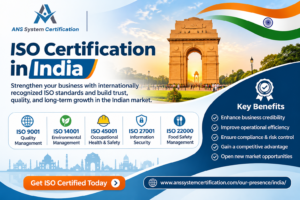
Different industries require different management systems. Some widely adopted ISO standards in India include:
1. ISO 9001 Certification – Quality Management System
ISO 9001 helps organizations establish an effective Quality Management System (QMS). It focuses on customer satisfaction, process improvement, quality control, and consistent service delivery. Manufacturing companies, service providers, construction businesses, and other organizations can benefit from ISO 9001 certification.
2. ISO 14001 Certification – Environmental Management System
ISO 14001 supports organizations in managing their environmental responsibilities. It helps businesses identify environmental impacts, manage waste, improve resource efficiency, and establish environmentally responsible operational practices.
3. ISO 45001 Certification – Occupational Health and Safety Management System
ISO 45001 focuses on workplace health and safety. It helps organizations identify occupational hazards, assess workplace risks, prevent injuries, and establish safer working environments for employees.
4. ISO 27001 Certification – Information Security Management System
ISO 27001 provides a systematic framework for protecting sensitive business information. It is particularly beneficial for IT companies, financial institutions, software businesses, and organizations handling confidential customer information.
5. ISO 22000 Certification – Food Safety Management System
ISO 22000 helps food-related organizations establish effective food safety management practices throughout the food supply chain. Food manufacturers, restaurants, packaging companies, and food distributors can benefit from this standard.
6. ISO 13485 Certification – Medical Device Quality Management System
ISO 13485 is designed for organizations involved in the medical device industry. It establishes quality management requirements that support product consistency, regulatory compliance, and customer confidence.
Other important standards include ISO 20000-1, ISO 21001, ISO 22301, ISO 37001, ISO 41001, ISO 50001, ISO 55001, and ISO/IEC 27701.
ISO Certification Process in India
Obtaining ISO certification involves several steps to ensure that an organization’s management system meets the applicable standard requirements.
Step 1: Select the Appropriate ISO Standard
Identify the ISO standard that matches your organization’s industry, activities, and business objectives.
Step 2: Application and Scope Review
Submit the required organizational details, including company information, employee strength, locations, and proposed certification scope.
Step 3: Management System Preparation
Develop and implement the necessary policies, procedures, processes, and records according to the selected ISO standard.
Step 4: Stage 1 Audit
The auditor reviews the management system documentation and evaluates the organization’s readiness for the next audit stage.
Step 5: Stage 2 Audit
The auditor evaluates the actual implementation and effectiveness of the management system against the applicable requirements.
Step 6: Certification Decision
After reviewing the audit findings and closure of applicable nonconformities, the certification body makes an independent certification decision.
Step 7: Surveillance Audits
Periodic surveillance audits help verify that the organization continues to maintain the certified management system.
Factors Affecting ISO Certification Cost in India
The cost of ISO certification varies depending on several factors. These include the selected ISO standard, organization size, number of employees, operational complexity, number of locations, and certification scope.
Businesses should request a detailed quotation from a certification body and understand the applicable audit requirements, certification charges, surveillance arrangements, and accreditation details before proceeding.
Why Choose ANS System Certification for ISO Certification in India?
Selecting a professional certification body is an important decision for organizations seeking reliable and internationally recognized certification services.
ANS System Certification provides ISO certification services to organizations across different industries in India. Its services cover various management system standards, including quality management, environmental management, occupational health and safety, information security, food safety, and other specialized systems.
With a focus on impartial auditing, transparent assessment procedures, and professional certification support, ANS System Certification helps organizations understand the certification process and work towards meeting applicable ISO requirements.
Conclusion
ISO Certification in India is an effective way for businesses to strengthen their management systems, improve operational efficiency, and build lasting customer confidence. From quality management and environmental responsibility to workplace safety and information security, ISO standards provide valuable frameworks for achieving sustainable business growth.
Organizations planning to expand their market presence, improve internal processes, and demonstrate their commitment to quality should consider implementing the appropriate ISO management system. Partnering with a professional certification body such as ANS System Certification can help businesses understand the assessment requirements and move towards successful certification.